
For most of the past decade, quantum computing lived in the “someday” category. Then 2025 happened. By the time the year closed, the field had record-breaking machines, commercial deployments running in production, and investment numbers that made it impossible to dismiss as a science project. Viewed from 2026, the shift is hard to overstate: the conversation moved from whether quantum computers will be useful to which problems they’re useful for right now.
The skepticism was loud at the start. In January 2025, Nvidia’s Jensen Huang said genuinely useful quantum computing was still 15 to 30 years away. The industry spent the rest of the year proving that timeline too pessimistic. The single change that made everything else possible wasn’t a flashy chip; it was error correction finally working at scale. That’s where any honest account of the latest breakthroughs in quantum computing has to start.
What it means for you right now
If you run or advise an organisation, the practical takeaway isn’t “buy a quantum computer.” It’s “start migrating your encryption.” The most actionable consequence of 2025’s progress is that the timeline for quantum-safe cryptography compressed sharply, and that affects everyone holding sensitive data, regardless of whether they ever touch a qubit.
Quantum computing now suits enterprises in logistics, finance, materials science, and pharma that have concrete optimization or simulation problems and the appetite to pilot. It does not yet suit anyone expecting a general-purpose machine that beats classical hardware across the board, because that doesn’t exist. The main risk is hype-driven procurement based on vendor benchmarks that aren’t comparable. The thing to check before acting is whether a claimed result was independently verified and against which classical baseline.
Error correction turned a physics problem into an engineering one
Qubits are fragile. Vibration, heat, stray electromagnetic noise, almost anything nudges them into errors. For years the fix was to add backup qubits, but scaling made it worse: bigger machines generated errors faster than the corrections could catch them. That trap is what kept “useful quantum” perpetually distant.
In 2025 the dam broke. A wave of error-correction advances arrived from QuEra, Alice & Bob, Microsoft, Google, IBM, Quantinuum, IonQ, Nord Quantique, Infleqtion, and Rigetti, among others, both by making individual qubits less error-prone and by improving the correction codes themselves. The consequence matters more than any single announcement: building a large, useful quantum computer stopped being a basic-science gamble and became an engineering challenge. Engineering progresses on schedules; science breakthroughs don’t. That reframing is why IBM and IonQ both published aggressive roadmaps in mid-2025, with IBM targeting a large-scale fault-tolerant machine by 2029 and IonQ projecting tens of thousands of logical qubits by 2030.
Record hardware, and no single winning design
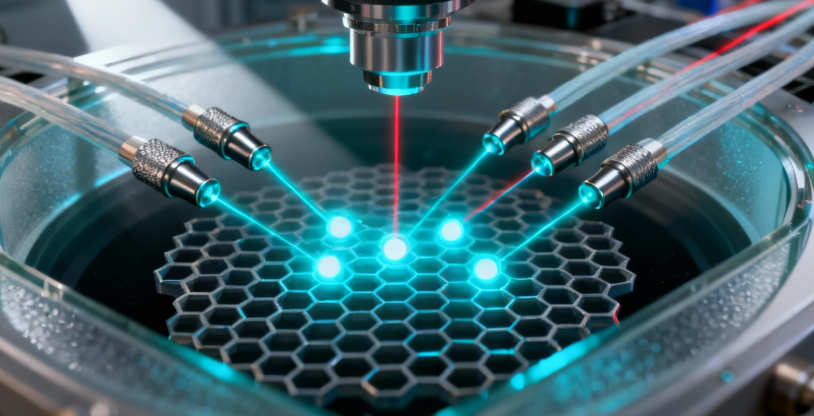
The headline hardware number of the year came from Caltech, which built a 6,100-qubit array by splitting a laser into roughly 12,000 parts to trap that many cesium atoms. The qubits held superposition for about 13 seconds, ten times longer than earlier arrays, and could be physically moved around, which opens the door to more efficient error correction in neutral-atom systems.
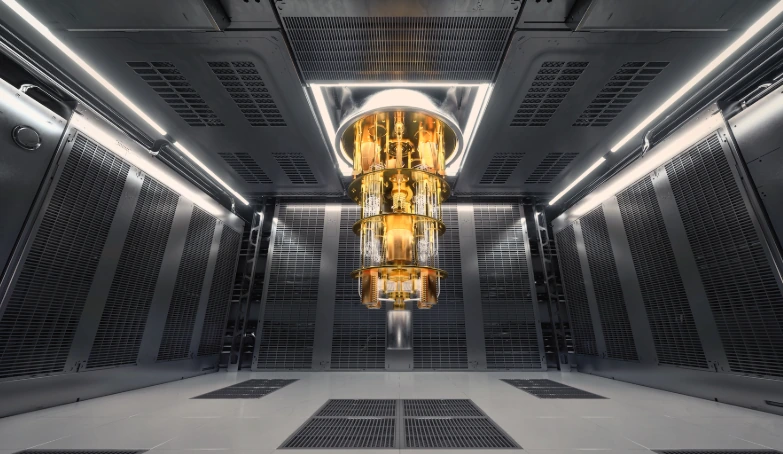
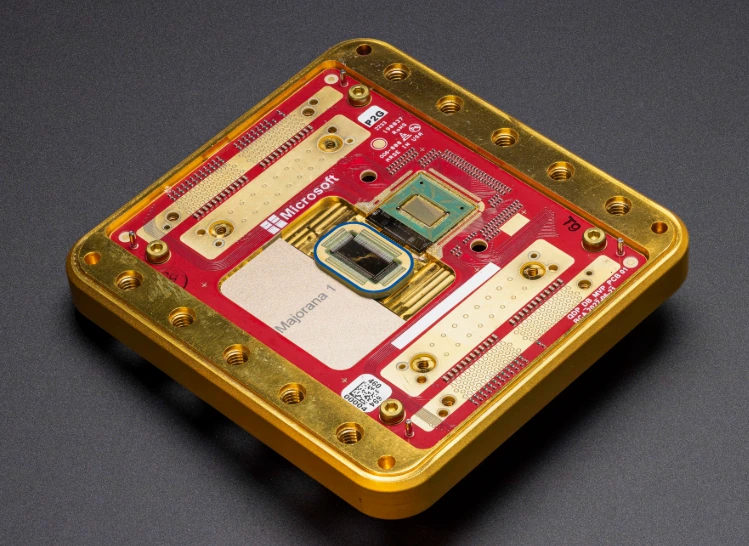
On the commercial side, Quantinuum launched its Helios machine in November 2025, built on trapped-ion technology with around 98 high-fidelity qubits and accuracy the company claims is the best available. What stands out is less the raw count than the architecture diversity. The field spent 2025 refusing to crown a winner. Superconducting “chandelier” machines remain prominent, but Microsoft pushed topological qubits with its Majorana 1 chip, Amazon combined cat and transmon qubits in Ocelot, and silicon-spin, photonic, and neutral-atom approaches all advanced. DARPA’s benchmarking shortlist alone spans neutral atoms, silicon spin, superconducting, trapped ion, and photonic qubits. For anyone evaluating the space, that means betting on a single hardware approach is still premature.
Real commercial use, not just lab demos
The most meaningful shift for non-physicists is that companies started reporting concrete gains in production, not press-release theater. A handful of documented 2025 cases show the shape of early value.
| Organisation | Quantum approach | Reported result |
|---|---|---|
| HSBC | IBM Heron processor | ~34% better bond-trading predictions vs classical alone |
| Ansys | IonQ system | ~12% faster fluid analysis in medical devices |
| Ford Otosan | D-Wave annealing | Scheduling cut from 30 minutes to under 5, in production |
The Ford Otosan case is the telling one because it’s deployed, not piloted. D-Wave’s machine isn’t a general-purpose computer; it’s an annealer suited to optimization problems like scheduling and supply chains, which is exactly where it delivered. Sentiment data backed the trend: in one 2025 survey of optimization leaders, a large majority said they’d hit the ceiling of classical computing, and roughly half were already planning to fold quantum into their workflows. Analysts at Bain estimated quantum could eventually unlock up to $250 billion of value across pharma, finance, logistics, and materials, even though the total market today sits under $1 billion.
“Quantum advantage” claims, and why you should read them skeptically
Several players declared quantum advantage in 2025, where a small quantum machine beats a giant classical supercomputer. D-Wave claimed it on a magnetic-materials simulation. China’s Jiuzhang 4.0 photonic machine claimed it on a narrow Gaussian boson sampling task, estimating a classical supercomputer would need longer than the age of the universe. IonQ claimed advantage in drug discovery and chemistry. Google ran a verifiable test it said was 13,000 times faster than the best classical supercomputer, notable because the algorithm could be independently checked.
The catch is comparability. Each company benchmarks on the problem that flatters its own hardware, and there’s been little standardized verification of what classical baseline was used or how much classical work was bundled in. IBM spent part of 2025 publishing benchmarks and a paper arguing that genuine, agreed-upon quantum advantage requires industry consensus, which it expects before the end of 2026. Until that consensus exists, treat any single “we beat classical” headline as a marketing claim first and a scientific result second.
The money confirmed the mood
Capital validated the technical progress. Quantinuum’s latest round, joined by Fidelity, pushed its valuation to around $10 billion. Photonic-qubit firm PsiQuantum became the most funded quantum startup after raising about $1 billion, reaching roughly a $7 billion valuation. Across the field, quantum companies raised about $3.77 billion in equity in the first nine months of 2025, nearly triple all of 2024. Governments moved too, with national investment reaching roughly $10 billion by April 2025, up from $1.8 billion the prior year, and DARPA selecting eleven firms for up to $15 million each to push toward utility-scale computing by 2033. Publicly traded names like IonQ, Rigetti, D-Wave, and Quantum Computing saw share prices swing wildly upward over the year, which is as much a caution about volatility as a sign of confidence.
Quantum and classical, stitched together
Nobody is replacing classical supercomputers; they’re pairing with them. Nvidia leaned hardest into this, announcing NVQLink, an open architecture for coupling its GPUs with quantum processors and integrating with its CUDA-Q software, with most of the major quantum firms signed on as partners. IBM demonstrated the principle by running its Heron processor alongside Japan’s Fugaku supercomputer to simulate molecules beyond what classical machines manage alone. The logic is simple: let each machine do what it’s best at, and have them talk. For the foreseeable future, “quantum computing” in practice means hybrid quantum-classical-AI systems, not standalone quantum boxes.
The security countdown you can’t ignore
The breakthrough with the widest reach landed in cryptography. In May 2025, Google researchers combined better error correction, improved quantum operations, and more efficient algorithms to make breaking RSA encryption roughly 20 times easier than previously estimated. That shortens the runway for migrating to quantum-safe encryption. The threat isn’t only future decryption; adversaries can harvest encrypted data now and decrypt it later once hardware catches up. The partial relief is that NIST has finalized its first post-quantum cryptography standards, giving organisations concrete algorithms to adopt.
Where this leaves things heading into the rest of 2026
The field’s center of gravity shifted from possibility to deployment, capped fittingly by a 2025 Nobel Prize in Physics for foundational 1980s work on superconducting quantum circuits, the technology underpinning many of today’s leading machines. The honest summary for 2026: error correction is the real engine, hardware diversity is still a live contest, commercial wins are real but narrow, and benchmark claims need scrutiny.
If you take one action from all of this, make it the cryptography migration, because that risk is here regardless of how fast the machines improve. Watch for the industry-standard benchmarks IBM expects to firm up this year; once those exist, separating genuine quantum advantage from marketing will get far easier, and that’s the moment to revisit any serious quantum investment.